
CCTV Survey Engineer Ramsgate
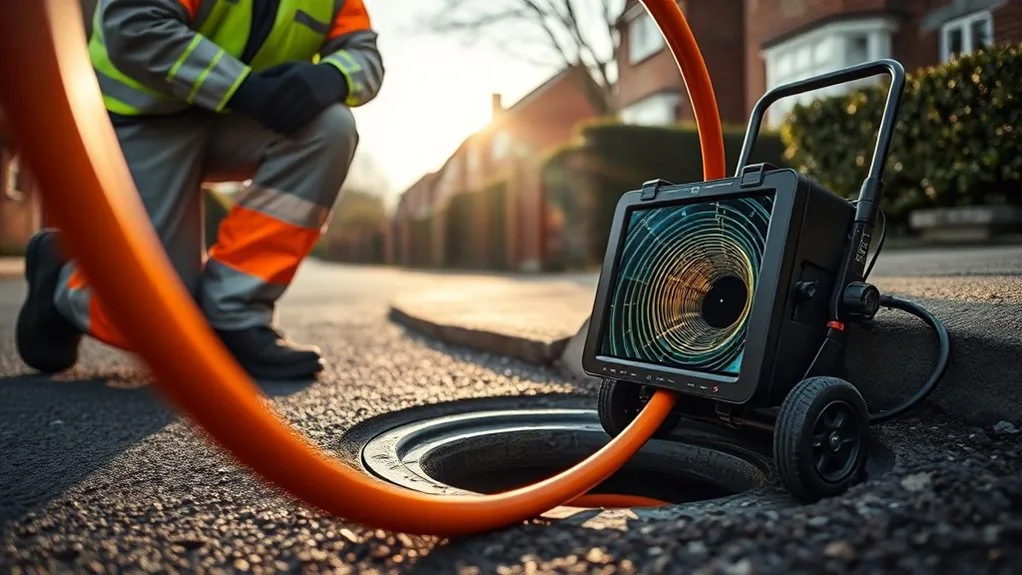
Blocked or damaged drains can cause significant disruption and expense. Using high-resolution CCTV cameras and live fault mapping, engineers quickly identify issues like blockages, leaks, and structural defects without the need for excavation.
Call now for a fast quote or emergency callout in Ramsgate.
Although traditional drain inspections rely on guesswork and excavation, a CCTV drain survey uses high-resolution cameras fed through your pipework to deliver a precise, real-time view of your drainage system’s internal condition. You’re effectively getting a non-invasive, full-length pipe inspection without breaking ground or lifting floors.
A specialist drain camera is inserted via an access point and pushed or robotically driven through the line. The camera head often includes LEDs, self-levelling capability, and a sonde for accurate depth and location tracking. Live video is relayed to a monitor, where an engineer assesses pipe material, diameter, gradients, and joint integrity, while identifying blockages, root ingress, cracks, or collapses. The footage’s then recorded, logged, and used to generate a structured survey report and remedial plan.
When you’re facing persistent drain blockages, foul odours indoors, slow draining fixtures, or repeated overflow incidents, these are key indicators that something’s wrong within your underground pipework. Rather than relying on guesswork or temporary chemical treatments, you need a method that pinpoints structural defects, obstructions, and misalignments with precision. A CCTV drain survey lets you see exactly what’s happening inside your drains so you can implement targeted, long-term repairs instead of recurring emergency callouts.
Even after repeated plunging, rodding, or chemical treatments, drains that keep slowing, backing up, or gurgling indicate a persistent blockage that’s no longer just a surface-level issue. At this stage, basic drain cleaning isn’t enough; you need a targeted pipe inspection using CCTV to see exactly what’s happening inside your system.
CCTV drain surveys let you identify structural defects, heavy scale, intrusive roots, or collapsed sections that repeatedly trap debris. You’ll get precise visual evidence, not guesswork, so remedial work can be accurately planned.
| Symptom | Likely Hidden Cause | How CCTV Survey Helps |
|---|---|---|
| Recurring slow drains | Scale or fat deposits | Maps restriction points |
| Regular toilet backups | Displaced or cracked joints | Confirms extent of damage |
| Gurgling from multiple fixtures | Partial main line obstruction | Locates exact blockage location |
Persistent blockages aren’t the only warning sign that something’s wrong inside your drainage system; foul odours indoors often indicate leaking, stagnant, or decomposing waste trapped within hidden pipework. When you notice sewage-type smells around sinks, toilets, or floor drains, your indoor air quality is already being compromised by hydrogen sulphide and methane vapours.
A CCTV drain survey lets engineers trace odours to precise defects: cracked pipes, collapsed sections, displaced joints, or foul water backfall creating stagnant pools. High-resolution cameras record internal pipe conditions, pinpointing breaches where gases escape into your property. With accurate diagnostics, contractors can target repairs, re-line pipes, or clear accumulations, rather than guesswork. This technical approach delivers long-term odour elimination, safeguards health, and prevents progressive structural damage.
Ever noticed sinks, showers, or toilets in your Ramsgate property draining more slowly than they used to, despite repeated plunging or chemical cleaners? That persistent slow drainage often indicates more than a simple surface blockage. It can signal partial collapses, fat and scale build‑up, root intrusion, or misaligned joints within the underground pipework.
A CCTV drain survey gives you a precise pipe inspection, showing real‑time footage of internal conditions from gully to connection point. Technicians can identify exact locations, depths, and causes of restriction, then specify targeted remedial work instead of guesswork. Integrating CCTV findings into a proactive drain maintenance plan helps you schedule cleaning, descaling, or repairs at the right intervals, preventing gradual slow‑downs from turning into disruptive, costly failures.
When toilets back up, external gullies overflow, or internal drains surge during heavy use, and these incidents keep recurring despite basic clearing, they’re strong indicators of a deeper fault that warrants a CCTV drain survey on your Ramsgate property. You’re likely facing structural defects, root ingress, or partial collapses that simple rodding can’t resolve.
A technical CCTV drain inspection tracks the entire run, recording high‑resolution footage, measuring pipe gradients, and identifying displaced joints, cracks, and fat or scale deposits. This evidence-led approach lets you target sewer maintenance precisely, rather than guessing. Engineers can map your system, classify defects by severity, and recommend remedial works such as lining, cutting roots, or re‑grading sections, preventing further overflows and reducing emergency callouts.
Although every drainage system is different, CCTV drain surveys in Ramsgate tend to reveal a consistent set of underlying issues: accumulated fat, oil and grease (FOG) deposits, incorrect or degraded pipe gradients, invasive tree root ingress, structural defects such as cracks, fractures and collapsed sections, displaced or misaligned joints, and obstructions from foreign objects or poorly designed connections.
Using a high‑resolution drain camera for detailed pipe inspection, you’ll typically see:
Identifying these common causes accurately lets you target only the sections that genuinely need intervention.
When we handle your CCTV drain survey in Ramsgate, we start with a structured diagnosis and camera inspection to map defects, blockages, and pipe condition in real time. Based on what we see, we apply targeted clearance methods such as high-pressure jetting or mechanical rodding to restore full bore flow. If the footage confirms structural issues, we’ll specify whether localised repair, patching, or full-length relining is the most efficient, long-term solution for your system.
Ever wondered what actually happens during a CCTV drain survey in Ramsgate once you’ve reported a problem? First, your drains are accessed via an inspection chamber or appropriate entry point. A high-resolution camera is then fed through the pipework, transmitting live video to our engineer’s screen for precise pipe inspection.
Every joint, connection, and change in pipe diameter is examined for cracks, root ingress, scale, corrosion, displacement, or structural collapse. We log distances, pipe material, gradients, and flow characteristics, building a clear map of your system.
This data is captured and stored, forming the basis of a structured drain maintenance plan. You’ll receive a detailed report, annotated still images, and video evidence, so you understand the exact fault location and severity.
Once the CCTV survey has identified where deposits, roots, or hardened scale are restricting flow, high-pressure water jetting is deployed to restore the pipe’s internal diameter. Using insights from advanced camera technology, technicians select calibrated nozzles, pressures, and flow rates that match your pipe material and condition, preventing damage while maximising debris removal.
| Jetting Focus | Technical Detail | Result for You |
|---|---|---|
| Scale removal | Rotating jets fracture mineral build-up | Restored flow capacity |
| Root ingress | Directed cutting jets sever fine root hairs | Reduced blockage risk |
| Grease deposits | Hot/high-flow jets emulsify FOG | Cleaner, smoother bore |
| Silt and debris | Rear jets drag waste to access points | Easier ongoing drain maintenance |
You get a thoroughly cleaned system, ready for post-jetting inspection and long-term performance.
Although high-pressure jetting resolves most soft blockages, certain obstructions demand physical intervention, which is where targeted rodding and mechanical clearance come in. Using live CCTV pipe inspection, technicians identify the exact location, type, and density of the blockage before selecting the appropriate rods or mechanical heads.
You’ll benefit from sectional rodding for tight bends and branch lines, while mechanical cutters and augers tackle compacted scale, encrusted fat, or intrusive debris. Controlled rotation and feed rates prevent damage to pipe walls and joints, maintaining structural integrity.
Once the line is clear, a follow-up CCTV survey verifies full bore flow and confirms no residual snag points, forming a precise record that supports proactive drain maintenance and future troubleshooting.
When CCTV drain surveys in Ramsgate reveal defects that cleaning alone can’t resolve, the footage becomes a precise blueprint for targeted repair or relining. You’ll see exact locations, pipe diameters, gradients, and defect types, allowing you to decide on the most efficient corrective method.
If the survey identifies cracks, displaced joints, or early-stage pipe corrosion, no-dig relining is usually recommended. A resin-saturated liner is inserted and cured in place, creating a seamless new pipe within the old, minimising excavation and disruption.
Where structural failure, severe deformation, or root ingress is advanced, we’ll specify sectional repair or full pipe replacement. The survey report doubles as a long-term drainage maintenance plan, helping you prevent repeat failures and budget accurately for future works.
Need a CCTV drain survey in Ramsgate without waiting days for an appointment? You get a rapid, scheduled slot based on priority, location, and risk of system failure. Our emergency response process starts with triage: you describe symptoms (backups, odours, flooding), we match them to likely defects and deploy the right camera kit—push-rod, crawler, or pan-and-tilt—so you’re not waiting on the wrong team.
Engineers are dispatched from multiple Ramsgate hubs, minimising travel time to urban and rural sites. On arrival, they isolate affected runs, complete the CCTV drain survey, and immediately interpret footage on-site. You receive a clear diagnosis plus short-term stabilisation measures and medium-term drain maintenance recommendations, reducing downtime and preventing repeat blockages or structural failures.
Because drain ownership in Ramsgate is split between private property owners, water companies, and sometimes local authorities, responsibility for a CCTV drain survey depends on exactly where the defect sits in the network. You’re usually responsible for drains within your boundary up to the point they connect to a shared or public sewer.
For private sections, you must arrange and fund the CCTV inspection, ensuring the contractor’s survey equipment and reporting comply with current drainage regulations and your insurer’s requirements. Once the issue lies in an adopted or public sewer, the statutory water company typically takes over, specifying its own survey standards.
If you’re unsure, site plans, manhole positions, and sewer adoption records help precisely define who must commission the survey.
Although CCTV drain surveys in Ramsgate are typically reactive, they’re far more effective if you integrate them into a structured prevention plan that targets the root causes of blockages, infiltration, and structural failure. You’ll reduce emergency callouts and extend pipework life by using survey data to drive preventative maintenance and strict drainage hygiene.
Use each survey report to create an asset register and risk profile, then schedule targeted interventions, such as:
From initial consultation to final report, you get a technically robust, end‑to‑end CCTV drain survey service that’s engineered around Ramsgate’s specific ground conditions, pipe materials, and regulatory requirements. We calibrate camera choice, cable length, and crawler configuration to suit chalk, clay, or made‑ground, ensuring accurate defect classification and geo‑location.
You benefit from engineers who understand both Historical techniques and modern infrastructure, so we can interpret old salt‑glazed systems as precisely as contemporary PVC or concrete lines. Our methodology is designed to minimise Environmental impact: no unnecessary jetting, reduced excavations, and optimised access points. Every survey delivers structured, standards‑aligned reports, high‑definition footage, and prioritised repair recommendations, so you can make fast, evidence‑based decisions on maintenance and investment.
You’ll naturally want clear answers on response times, pricing, and whether it’s worth attempting any drain checks yourself before booking a CCTV survey in Ramsgate. In this section, you’ll see how quickly we can schedule and complete surveys, what factors influence cost, and when DIY efforts risk masking or worsening structural issues. You’ll also get precise details on our Ramsgate coverage area so you can confirm we can attend your property without delay.
How fast can a CCTV drain survey be arranged in Ramsgate depends on engineer availability, site access, and the complexity of your drainage layout, but in most cases we can schedule same-day or next-day attendance for urgent issues. For routine drain maintenance, you’ll usually get a confirmed slot within 24–48 hours, subject to access permissions and any pre-survey risk assessments.
We allocate time for equipment calibration, vehicle loading, and travel so your slot’s used efficiently on site. Larger commercial systems or sites with confined-space requirements may need slightly longer lead times to coordinate teams and permits.
| Response level | Typical time frame |
|---|---|
| Emergency call-outs | Same-day where possible |
| Urgent domestic | Within 24 hours |
| Planned surveys | 24–72 hours, pre-booked |
Several core factors determine the cost of a CCTV drain survey in Ramsgate, including pipe length and diameter, access points, property type (domestic vs. commercial), the level of reporting you need, and whether additional services like jetting or tracing are required. These pricing factors influence survey duration, camera type, and crew size.
For a straightforward domestic survey, you’ll typically receive a cost estimate based on a fixed fee for the first length of pipework, then an incremental rate per additional metre. Commercial and larger sites are usually priced after a pre-survey assessment, accounting for multiple access chambers, complex layouts, and health and safety provisions.
Detailed reports with CAD drawings, condition grading, and repair recommendations add to cost but provide essential diagnostic value.
While it’s tempting to try and clear a drainage issue yourself before booking a CCTV survey, it’s important to distinguish between minor, low‑risk checks and work that could worsen the problem or breach regulations. You can try basic DIY tips such as running hot water, using a plunger on accessible internal wastes, and checking easily reached gully grates for leaf or silt build‑up.
Always follow safety precautions: wear gloves and eye protection, avoid mixing chemical drain cleaners, and never enter inspection chambers or confined spaces. Don’t feed makeshift rods, hoses, or cables into underground pipework; these can snag or puncture the drain. If blockages recur, there’s foul odour outside, or multiple fixtures back up, you’ll need a professional CCTV drain survey.
In most cases, yes – if you’re in Ramsgate, we’ll cover your area. Our engineers operate across the county, from coastal towns to inland villages, planning routes using major roads and Ramsgate landmarks to reach you quickly with full CCTV survey equipment.
We cover domestic, commercial, and industrial sites in and around Canterbury, Maidstone, Ashford, Medway, Thanet, Dartford, Gravesham, Tunbridge Wells, Sevenoaks, and surrounding rural locations. If your property borders another county, we’ll confirm feasibility based on access, travel time, and survey scope.
Wherever you’re based, we apply the same standards: HD camera systems, accurate pipe mapping, and reports aligned with local drainage regulations and water authority requirements. Contact us with your postcode and site type for confirmation.
Yes, a CCTV drain survey can be used as evidence in property disputes. It provides time-stamped footage, measurements, and condition reports that support legal documentation and dispute resolution. The survey includes a digital video file, annotated plans, and a written technical report, which can be presented to solicitors, surveyors, insurers, or the court as objective evidence.
You do not legally need a CCTV drain survey before buying a house in Ramsgate. However, it is advisable because it confirms the condition of drains and identifies issues like blockages, root ingress, and pipe corrosion that standard surveys may miss. The survey provides HD footage, structural grading, and mapped drain runs, helping to clarify responsibility and support price negotiations or repair requests before completion.
Yes, a CCTV survey can affect your home insurance and premiums. If the survey shows your drains are in good condition, it may improve your risk profile. However, if defects are found, insurers might ask for repairs or place exclusions on your policy. You should disclose any significant findings when applying or renewing your policy and provide evidence after any repairs. This can help ensure accurate risk assessment and reduce disputes over pre-existing drain issues.
Landlords should schedule CCTV drain surveys every 3 to 5 years for most properties and every 1 to 2 years for older systems. These surveys help identify blockages, check pipe gradients, and assess corrosion before serious damage occurs. It is advisable to increase the frequency after major blockages, building works, subsidence, or if tenants report slow drainage, foul odours, or gurgling sounds.
Yes, you can usually obtain a digital copy of the CCTV drain footage for your records. Request the file in MP4 format or a similar type, along with a survey report that includes timestamps. This will help you identify blockages, pipe corrosion, joint defects, and root ingress, and you can share the information with contractors or insurers. Confirm how long the footage will be stored, the file naming conventions, and whether a drain layout plan, still images, and condition grading are provided for accurate future maintenance.
Once you’re ready to move from guesswork to hard data, getting your CCTV drain survey sorted is straightforward and highly structured. You contact the team, outline the issue, and they specify the survey scope: pipe diameters, access points, property type, and required reporting format (e.g. homebuyer, build-over, or pre-tenancy).
An engineer then deploys high‑resolution cameras and push‑rod or crawler systems, chosen according to pipe length and material. They log distances, gradient changes, junctions, and defects in real time, while evaluating environmental impact such as potential groundwater contamination or root ingress.
Afterwards, you receive a digital report with time‑stamped footage, condition grading, and CAD‑ready plans. This lets you prioritise repairs, budget accurately, and benefit from ongoing technological advancements in diagnostics.